1838 TO 1853
The Specification
Pennsylvania built the South Fork dam to hold water for a canal.
Seventy two feet high. Nine hundred thirty one feet across the top.
Five cast iron pipes ran through a stone culvert at its base, so the lake could be let down whenever a man decided to let it down.
The dam worked for thirty six years.
1875 TO 1881
Four Decisions
Between 1875 and 1881 four things were done to the dam.
None of them cost much. None of them were secret. None of them were illegal.
What the dam could pass
Advance through the record. Nothing here can be put back.
- Five discharge pipes
- Original section at the 1862 break
- Full height of the crest
- An open spillway
1879 TO 1889
Sixty One Names
The South Fork Fishing and Hunting Club opened in 1881 with a clubhouse, cottages, and a stocked lake.
Membership ran to about sixty one men, most of them from Pittsburgh.
Several of them ran the largest companies in America.
The Club
Turn a card.
Membership ran to about sixty one men. The club stood fourteen miles upstream from a town of about thirty thousand people.
1880 TO 1889
The Warnings
The dam leaked. Everyone knew.
Johnstown told jokes about it.
An engineer wrote a report in 1880 saying the repair was bad and the lake could not be let down.
Nothing in that report was ever fixed.
John Fulton, engineer for the Cambria Iron Company, inspected the dam in 1880. He found the repaired section poorly built and no way to draw the lake down. Benjamin Ruff wrote back that there was no danger.
MAY 30 AND 31, 1889
The Rain
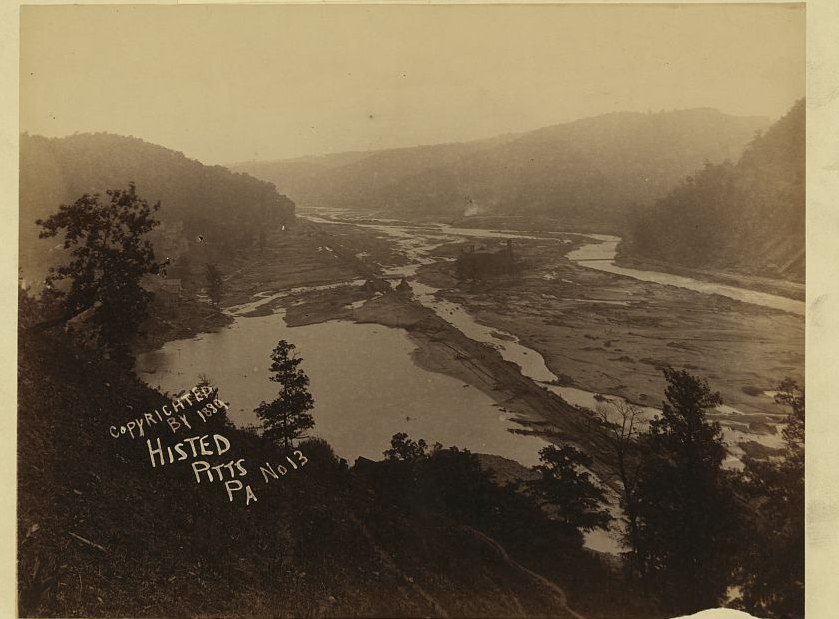
The heaviest rain the region had recorded fell across the Conemaugh watershed in about twenty four hours.
Rivers rose in every valley. Roads went under. Rail lines washed out.
At the lake, the water rose about a foot an hour.
Reported totals for the watershed run from six to ten inches in about a day. Gauges were few in 1889 and the higher figures are estimates.
MAY 31, 6:00 A.M. TO 3:00 P.M.
The Morning
At the dam, men dug a second spillway, tried to clear the screens, and raised the crest with earth.
In Johnstown, fourteen miles down the valley, the day went on.
One morning, two records
Move the clock.
Warnings that the dam might fail had reached this valley in 1881, in 1885, in 1887, and in 1888.
3:10 P.M.
The Dam Gave Way
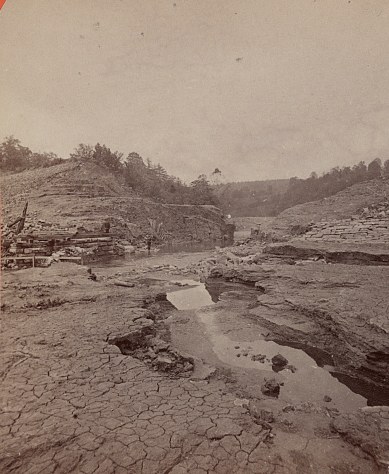
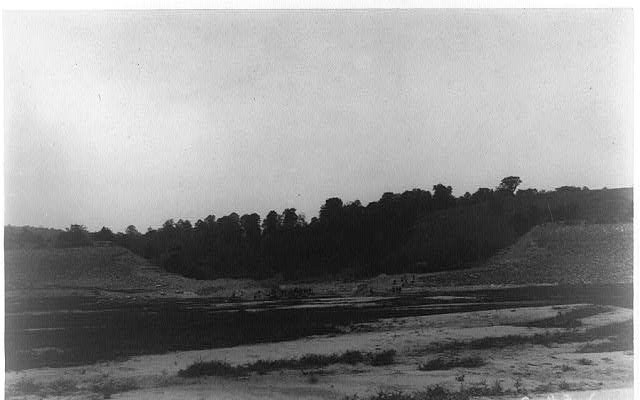
Twenty million tons of water left the lake in about forty minutes.
For part of that time it came down the valley at a rate comparable to the flow over Niagara Falls.
The lake bed was empty by four o'clock.
3:10 TO 4:07 P.M.
Fourteen Miles
Fifty seven minutes from the dam to Johnstown.
Fifty seven minutes
Move the front down the valley.
The valley drops about 450 feet in 14 miles. The profile is simplified between the two ends.
The victim list published in 1890 recorded the dead by where they were buried rather than where they lived, so per community counts vary between accounts. The total does not.
MAY 31 TO JUNE 3
The Pile at the Bridge
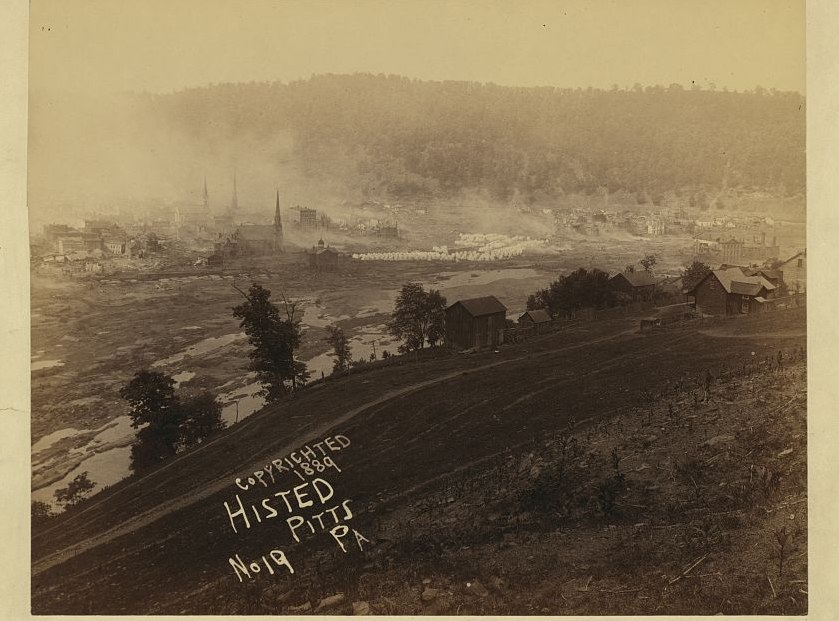
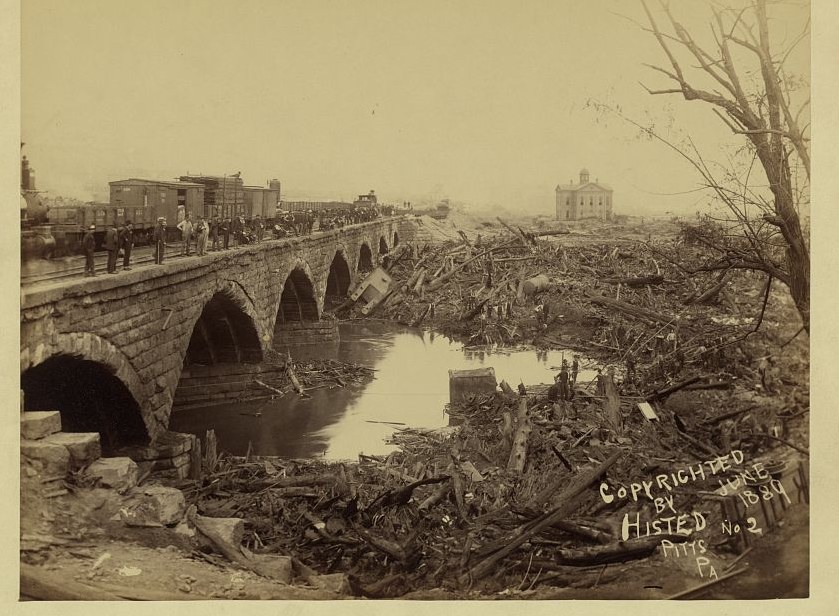
Below Johnstown the valley turns and a stone railroad bridge crosses it.
Everything the flood carried piled against that bridge and stopped. The pile covered about thirty acres and stood up to forty feet deep.
Then it caught fire and burned for three days.
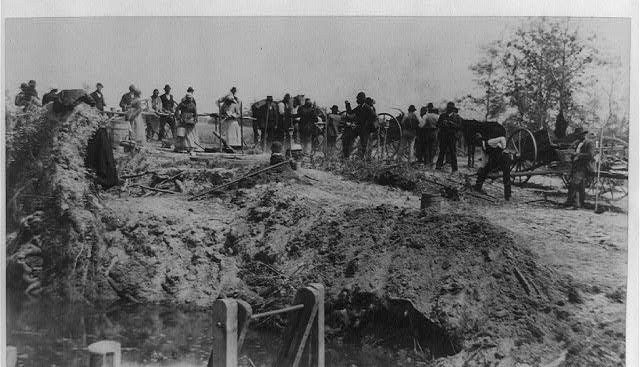
At least eighty people died in the debris after surviving the water.
WHAT WAS COUNTED
The Count
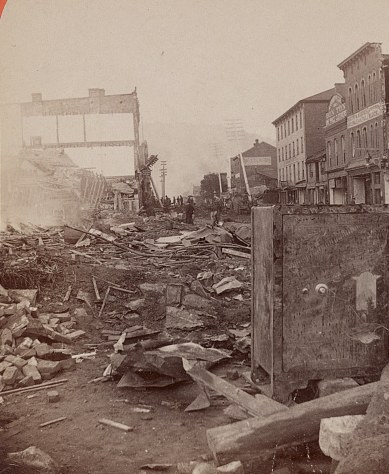
- 2,209dead.
- 99entire families, gone, with nobody left to report them missing.
- 396children died with those families.
- More than 750people were never identified.
- 1,600homes destroyed. About 17 million dollars in damage.
- 1911The last body was found that year, in Millvale near Pittsburgh, twenty two years later.
1889 TO 1891
Nobody Paid
Suits were brought against the South Fork Fishing and Hunting Club.
Every one of them failed.
The club had been organized so that members' personal assets sat outside it. Two of the lawyers who defended the members were members.
Not one victim or heir ever recovered a dollar from the club.
The Account
Open each line.
| WHAT IT COST | WHO PAID IT |
|---|---|
| PAID BY THE SOUTH FORK FISHING AND HUNTING CLUB | $0 |
Two of the attorneys defending the club were members of the club. One of them, Philander Knox, later served as Attorney General of the United States.
1891 AND 2016
Could It Have Held
In 1891 a committee of engineers investigated and concluded the dam would have failed in that storm no matter what had been done to it.
In 2016 three researchers ran the numbers again and reached the opposite conclusion.
The same storm, two dams
Run the storm.
1891, American Society of Civil Engineers committee: the storm was extraordinary enough that the dam would have failed regardless of the alterations.
2016, Coleman, Kaktins, and Wojno, University of Pittsburgh at Johnstown: the dam as originally designed and built would never have been overtopped and destroyed by the 1889 storm.
WHY THE DAM WAS LOWERED
So that two carriages could pass each other on the road across the top.
2,209
NINE WORDS YOU ALREADY MET
Terms
Every term below appeared in something you just read. Each one names a thing you already watched happen.
| TERM | WHAT IT MEANS | WHERE YOU MET IT |
|---|---|---|
| spillway | A channel that carries off water when a reservoir rises above its intended level | The rock channel at the eastern end, screened for fish in 1881 |
| freeboard | The distance between the surface of the water and the top of a dam. It is the entire reserve during a storm | About three feet of it went into a carriage road |
| discharge capacity | How much water a structure can move out of a reservoir in a given time | Cut by roughly half between 1875 and 1881 |
| watershed | All the land whose rainfall drains into one river or lake | Six to ten inches of rain fell across the Conemaugh watershed in about a day |
| liability | Legal responsibility for harm, and the obligation to pay for it | Every suit against the club failed |
| negligence | Failing to take the care a reasonable person would take. In Pennsylvania in 1889 this was what a victim had to prove | The standard the club's defense was built to survive |
| act of God | A legal argument that harm was caused by natural forces no person could have prevented | The club's defense, and the finding of the 1891 engineering committee |
| indemnity | Compensation paid for loss or damage | Not one victim or heir received any from the club |
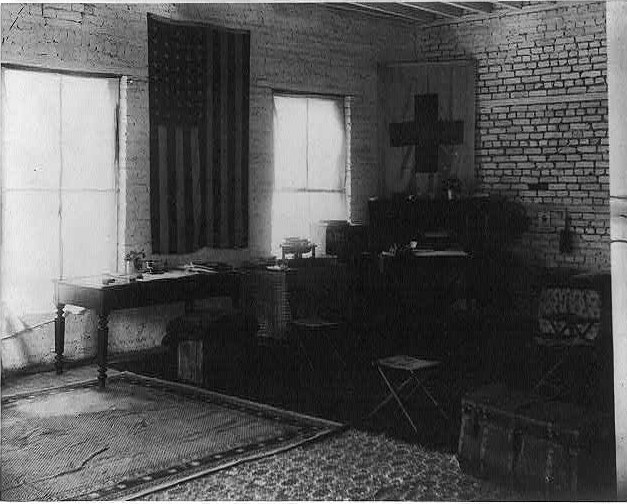
| relief | Aid given to people after a disaster, usually raised by donation rather than owed by anyone | $3,742,818.78, and five months of Clara Barton's time |
CHECK WHAT YOU WROTE DOWN
Note Repair
Six statements. Each one is the version people usually leave with. Each one is wrong.
| WHAT PEOPLE USUALLY WRITE | WHAT THE RECORD SAYS | WHERE TO CHECK |
|---|---|---|
| The dam burst without warning | The dam had leaked for years, an engineer warned about it in 1880, warnings that it might fail came down the valley in 1881, 1885, 1887, and 1888, and men worked on it all morning on May 31 | The Warnings · The Morning |
| The club was reckless and nobody could have missed it | Every alteration had an ordinary reason behind it and none was hidden. The failure was the sum of four cheap decisions, not one obvious one | Four Decisions |
| The flood was caused by the rain | The rain was extraordinary and the storm is real. Whether the dam would have failed without the alterations is disputed by two competent engineering investigations reaching opposite conclusions | The Rain · Could It Have Held |
| The wealthy owners were eventually made to pay | Every suit failed. Not one victim or heir recovered anything from the club. Two of the defense attorneys were club members | Nobody Paid |
| Everyone died in the water | At least eighty people survived the flood and then died in the debris fire at the stone bridge, which burned for three days | The Pile at the Bridge |
| Nobody knows exactly how many died | 2,209 is the accepted figure. More than 750 were never identified, 99 entire families died with no survivor left to report them, and 396 children died with those families | The Count |
WHERE THESE FIGURES COME FROM
Primary and archival
- John Fulton, inspection report on the South Fork dam for the Cambria Iron Company, 1880, and Benjamin Ruff's reply.
- American Society of Civil Engineers, Report of the Committee on the Cause of the Failure of the South Fork Dam, 1891.
- The Victims of the 1889 Johnstown Flood, Johnstown Tribune, July 31, 1890.
- Photographs: Library of Congress, Prints and Photographs Division. Work by Histed of Pittsburgh and stereographs by George Barker, 1889. No known restrictions on publication.
Reference
- National Park Service, Johnstown Flood National Memorial.
- Johnstown Area Heritage Association and the Johnstown Flood Museum.
- Neil M. Coleman, Uldis Kaktins, and Stephanie Wojno, dam breach hydrology of the Johnstown flood of 1889, University of Pittsburgh at Johnstown, 2016.
- David McCullough, The Johnstown Flood, 1968.
Where sources disagree
- A later revision of the death toll gives 2,208 after a duplicate record was found. This page uses the accepted 2,209.
- The 1891 committee assumed the crest was lowered about two feet. The 2016 study found close to three.
- Accounts give thirty six to forty five minutes for the lake to empty, and some give more than eighty deaths in the fire at the bridge.